


Unlocking Secure Research Environments with Azure Virtual Desktop: A Conversation with Pauline Thomas
TL;DR
Azure Virtual Desktop (AVD) is transforming how research environments achieve security, compliance, and operational efficiency. By simplifying alignment with the Essential Eight, embedding Zero Trust principles, and automating critical controls, AVD removes the complexity traditionally associated with managing secure workspaces. Researchers gain a protected, compliant environment where data storage, authentication, and authorisation are handled seamlessly, enabling them to focus on innovation, not infrastructure.
At the eResearch Conference in Brisbane, surrounded by innovators discussing data platforms, high-performance computing, and generative AI, Macquarie Cloud Services took a moment to highlight a different, yet equally critical topic: Azure Virtual Desktop (AVD) and its transformative impact on secure research environments.
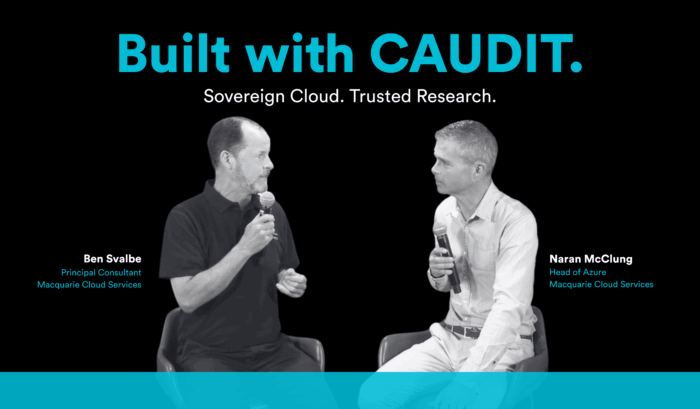
Our very own Naran McClung sat down with Pauline Thomas, Lead Product Manager for our Azure business, to unpack why AVD matters, especially for researchers navigating sensitive data, compliance requirements, and the need for seamless access to powerful computing environments.
What followed was a short but insightful exchange that cut right to the core of what makes AVD essential today.
Why AVD Matters More Than Ever.
AVD, as Pauline explains, is essentially a secure, cloud-hosted workspace available in both Azure’s public and private cloud. It brings together three elements rarely found in one sentence: innovation, security, and compliance.
And during the pandemic, when remote work became the norm, AVD emerged as one of Microsoft’s most in-demand solutions, second only to Microsoft Teams. This skyrocketing adoption wasn’t a surprise. Organisations needed fast, scalable, secure environments for dispersed teams, and AVD delivered exactly that.
AVD + Essential Eight = A Powerful Security Foundation.
One of the conversation’s most compelling points was the link between AVD and the Essential Eight cyber security framework.
The Essential Eight outlines eight core mitigation strategies designed to protect organisations from cyber threats. While critical, these strategies can be challenging to implement, particularly for teams without deep cybersecurity expertise.
This is where AVD shines.
Pauline explains that Macquarie Cloud Services deploys AVD with built-in baselines grounded in:
- Zero Trust principles
- The Essential Eight maturity model
These security settings are automated and embedded into the deployment. This means organisations, and especially researchers, don’t need to manually worry about:
- Where their data is stored
- Authentication and MFA
- Multi-user authorisation
- Compliance controls
It’s all baked into the service.
Why Researchers Benefit Most.
Researchers often handle sensitive, high-value data and must operate in controlled environments. For them, security isn’t optional, it’s non-negotiable.
AVD provides them with:
- A secure and isolated workspace
- Consistent access to tools and data
- Compliance aligned to their institutional requirements
- Freedom from the overhead of managing infrastructure
As Naran put it, the connection between AVD and research environments just feels natural.
The dialogue ends with a simple, almost poetic exchange:
“I feel like we’ve met this problem halfway.”
“I think we’ve met it full.”
A fitting summary for a solution that truly bridges the gap between innovation and security.
Full Interview Transcript.
Well, this is a special treat. Now you know who I am. I’m Naran and I work for Macquarie Cloud Services, and I’m here with one of my favourite people of all time, Pauline Thomas. Pauline is our lead product manager for the Azure business. Hello, Pauline Thomas.
Pleasure to be with you Naran.
Well, we are at the eResearch conference here in Brisbane, right? There’s lots of researchers running around talking about data platforms and high performance compute and generative AI, and lots of things like that. We’re talking about something different. Today we’re gonna talk about AVD. What is AVD for the audience?
AVD is Azure Virtual Desktop. Basically, it’s a secure bubble that’s hosted in the Azure public cloud or on a private cloud that gives you the best in innovation, in security, and in compliance. And you don’t often hear those three things put together in one sentence.
I see. Now I happen to know, you tell me if this is true, but through the COVID period, the two most popular products that Microsoft was selling when everybody was working from home.
Yep.
Teams obviously, and the other one was of course
Azure Virtual Desktop.
Azure Virtual Desktop. So the second most popular service that Microsoft have sold in living memory. I happen to know also from you all my knowledge comes from you, Pauline, that there’s a relationship between the Essential Eight and AVD. How does that work?
Yeah. So, Essential Eight obviously is the set of eight basic principles. Not so easy to implement by the way. That relates to compliance around security. Just the basic principles that every business, not necessarily governments or technical organisations, need to keep take to keep themselves safe. Now, AVD actually makes these set of eight principles comparatively easy to advance in maturity, and that’s simply because it addresses the secure bubble that I was talking about in a very automated and innovative way.
I understand. Now, I have to assume that that’s attractive to researchers, right? Because they have to worry about data privacy.
Mm-hmm.
They have to work in a protected, controlled environment.
Yep.
It feels like these things go together for me.
It’s just built in. So when we deploy Azure Virtual Desktop in our way, um, the Macquarie Cloud Services way, we have things called baselines. And these baselines are built on zero trust principles as well as obviously Essential Eight. These things are automated and just get deployed.
Right.
So, the researcher doesn’t need to worry about where the data is stored because that’s taken care of.
Right.
They don’t need to worry about authentication or multifactor authentication, or even multi-user authorisation.
Interesting.
Because that’s all taken care of. It’s built into the service.
I see. Alright. All of which available to our friends here via CAUDIT Cloud, which is all of our capabilities combined with the ease of contracting through the ICTA framework.
I feel like we’ve met this problem halfway.
I think we’ve met it full.
Thank you very much for your time, Pauline.
Thank you.
Alright.